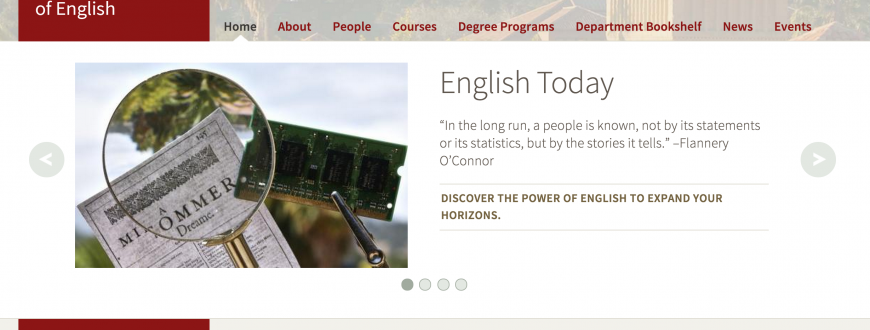
After years of maintaining a static site, the Stanford Department of English decided it was time for an upgrade.
In September 2012, the Stanford Department of English decided to revamp its website. The department wanted to establish a unique identity on campus for both current and prospective students. “Our old website was pretty old. [It was] really functional and the content was good, but it was outdated. We needed a facelift.”
The original website for the Department of English was custom built by the department’s Academic Technology Specialist (ATS) instead of using a content management system. This made it difficult for department administrators to update the site and edit content. “The site code was not well-documented, so changes to the site architecture were reliant on the person who built it,” said Nelia Peralta, Department Technology Specialist. “I was struggling; maintenance was pretty hard.”
The department hired Stanford Web Services to create a compelling new design that reflected the identity of the department in the context of the university, upgrade its custom CMS to Drupal, and rethink its site’s architecture and content strategy to better support its audience.
User Centered Design
By conducting a series of design and discovery workshops, we were able to work with the Department of English to identify primary audiences for the website and tailor the site architecture and design to support those audiences. The purpose of the discovery process was to uncover the department’s needs. “It was really fun because we had to do things like identify our audience, and how we wanted [the site] to look,” said Katie Dooling, Undergraduate Student Services Coordinator. “For me, I don’t have the technical language for the Internet. [Stanford Web Services] gave us the tools to say what we like and prefer, and gave us a way to communicate that.”
Customized Solutions
A primary factor in developing unique features was understanding the department’s personality and implicit needs. In addition to workshops and meetings, a useful resource for our team was the department’s annual newsletter. “Megan [Miller, Stanford Web Services User Experience Designer] got a lot of ideas because she read our newsletter first… SWS really took the time to get to know us; they really listened. It felt like they knew what we wanted even if we couldn’t communicate it,” Katie said.
The “Department Bookshelf” is a custom-built feature that came out of the discovery phase. The bookshelf is modeled after iBooks, and features English faculty publications. “I think it looks beautiful” Katie said, “We’re so literature focused, and our faculty is so prolific about writing. It’s so appropriate and useful to our site.” The bookshelf is a feature that is unique to the department, and represents its personality in an elegant and compelling way.
Content Strategy
One major challenge for the department was revamping the content from its old site to deliver an enhanced user experience to its users. Although the original site contained a lot of rich content, the site was difficult to navigate, thereby limiting the accessibility of its content. “We had all this content, but nowhere to put it,” Katie said. “What I remember doing is gathering a lot of what we had and finding ways to organize it, plug it in, and make it look good.”
With the content already provided from its original site, the department was focused on improving the language. As a department specialized in prose, it was especially important for the site’s content to resonate with both students and faculty. This required an equal balance of scholarly tone, and a delivery style fitting of the web. To help the Department of English administrators walk this line, we worked with them to better understand their audience and think strategically about how to capture its attention, such as using key verbs and highlighting the most valuable content.
The new Department of English website is a modern, fully responsive, content rich website that exemplifies the Stanford brand and unique identity of the department itself. The new site is rich in content and design. Students are able to navigate with ease, and find the information they are looking for. The site also allows faculty to update their profiles regularly and stay up to date on the various goings on of the department. “The department was big time excited. Our old site was fine in a lot of ways, but people definitely felt like it was time for an update.” Nelia said. “One of the biggest differences is the old website was very static. Now, it is very dynamic and not just a place for news.”
Another big win for the department is that site administration is no longer on the shoulders of one individual. By updating the site to a content management system (Drupal) instead of code, individuals with limited technical abilities are able to update the site regularly. “It’s really easy to upload new things or make edits, whereas with the old site, I didn’t even know where to begin. I even had to help another department with Drupal,” Katie said. “I feel like I’ve learned so much as someone who is not super tech-savvy.”
The Department of English site enabled our team to make several features development breakthroughs on creating custom designs, as well as re-usable features for publications, people, news, events, and carousel. In fact, many subsequent clients have used the department’s website as inspiration for their own. “A lot of sites at Stanford are modeled on our site,” Katie said, “We’re so proud of it. It’s really cutting edge.”
Working with the Department of English gave our team an exciting opportunity to capture the unique identity of a department and translate that into a compelling design. Building the site was a rewarding challenge, and a positive learning experience for both teams. “Stanford Web Services, who designed and built the site, were wonderful to work with throughout (I will never look at a Post-it note in the same way again),” Gavin Jones, Professor and Department of English Chair, said.
If you're interested in learning more about this project, contact SWS Manager, Sara Worrell-Berg SWS at swberg@stanford.edu.